 |
| Barcelona's La Sagrada Familia |
In all honesty, Spain was not on my "must see" list of places to go, nor was it even on my radar, until about nine months prior to my trip. While it was definitely a country I figured I would visit at some point in my lifetime, I had no yearning to visit it so soon. In fact, I had been planning on visiting Argentina for two weeks in March of 2009 but insanely expensive airfare between the destinations I planned to visit within Argentina pushed the trip out of my budget. I was quite disappointed as I had very much wanted to experience Argentina.
While discussing my dilemma with my sister, she brought up the idea of traveling to Spain as an alternative to Argentina. The two countries had obvious similarities; Spanish language, warm weather, rugged landscapes, and fascinating cultures. On the other hand, there was also glaring dissimilarities; different continents, moderately sized country compared to a massively sized country, and completely different histories, although they were obviously tied together. It was during this conversation with my sister that Spain began to appeal to me for several different reasons; I could taste the churros con chocolate as she described their delicious crunch to me, I could see the colorful and playful lines of Gaudi's architecture, I could hear the rhythmic sound of Flamenco music dancing through my ears, and I could feel the warm sun warming my body. All of this sounded so fascinating and exciting to me. In addition, the fact that I found relatively decent priced airlines tickets to Spain and that accommodations within the country were much less expensive than compared to the rest of Europe really caught my interest.
After adding all of the associated costs together (airfare, lodging, food and sightseeing estimates, car rental, etc) for two weeks in Spain compared to Argentina, the trip to Spain actually came out less, believe it or not. As soon as I could see that it was cheaper to travel to Europe than South America, the choice to travel to Spain became a no-brainer. I immediately began planning my two week trip, ultimately deciding to visit Barcelona, Granada, the white hill towns of Andalusia, Sevilla, Cordoba, Toledo, Segovia, and Madrid. Entries for this trip will be divided into separate entries according to the areas listed above.
Day 1 and 2 (Tuesday, March 24th and Wednesday, March 25th 2009)
Unfortunately, the direct flight I had managed to snag on Air France from Seattle to Paris left about 20 minutes late, so I left feeling slightly concerned as I had a 45 minute layover in Paris between my flight to Barcelona. However, I was hopeful that I would make up time during the flight and maybe even arrive a little early. For some reason I was unable to sleep well on the flight, which was frustrating as sleeping was a key importance in order to be able to enjoy my first day in Barcelona to the best of my ability. I watched several movies and enjoyed the good meals, which I have come to expect with Air France.
I finally arrived in Paris at 8:45; considering my next flight to Barcelona was scheduled to depart at 9:35, I was extremely concerned. I was hoping that I would be able to rush through the airport in order to make my flight but it didn't help knowing that my departing flight to Barcelona was leaving from a different gate than the one I arrived in.
Unfortunately, as many of you may or may not know, Charles de Gaulle is an absolute nightmare of an airport. In order to travel from one gate to another, I had to take a bus. Why this airport doesn't have an underground train system like so many other airports is beyond me. Once at the proper concourse (after what seemed to be the longest bus ride ever), I then had to go through customs. With my lovely luck, the lines were really long and it ended up taking me nearly 15 minutes to get through customs. While waiting, I ended up meeting a nice couple my age from Seattle. They were going to be in Europe for about ten days and were planning to visit Amsterdam, Bruges, Brussels and Paris. The thing I found really great about their trip was that the wife had planned it as a complete surprise for her husband’s birthday and had only informed him of the trip just a few days prior. She had done all of the leg work herself, including requesting vacation time from his boss!
As soon as I was finished with customs, I rushed through the airport as I had only 15-20 minutes until my flight was scheduled to depart. I kept hoping that it was running behind and would leave late so that I would have extra time! Much to my surprise and irritance, I was interrupted on my run through the airport by security. I hadn’t expected that I was going to have to go through security again, so I was quite annoyed and even more worried about missing the connection. To make matters worse, the security officials asked to look at my liquid bag several times and to top it off, all of the items in my liquid bag fell out!
After going through the stress of security, I ran like crazy in order to reach the gate. I actually managed to arrive at the gate seven minutes before the scheduled departure at 9:35, but the door was already shut and no airline official was at the gate. I was out of breath, pissed off, and beyond frustrated. I immediately walked over to one of the customer service counters of Air France and was rebooked on a flight three hours later to Barcelona. I felt incredibly irritated with my situation but knew that I had done everything within my power to make the flight and that it just wasn't meant to be. I decided not to dwell on the situation too much and realized that there could have been far much worse airports to get stuck in instead of Paris. While I waited, I went to eat in a café and ran into the nice couple again from Seattle. We talked together for about 30 minutes until their flight left to Amsterdam.
After sitting around for a few hours, my flight to Barcelona was announced and they indicated that it was running 20 minutes late due to some sort of mechanical problem. I finally started boarding soon after that, only to be turned around by the pilot as I walked down the breezeway. I began to feel quite nervous as it felt as though things just weren't going my way that day and that I would never make it to Barcelona. Luckily, I only had to wait another five minutes until I boarded again, and this time, I wasn't asked to turn around! The flight was quick and only lasted about 1.25 hours, but much to my surprise included a meal. European airlines are so much nicer than their American counterparts! I slept the entire way with the exception of the short time I ate the meal.
As my plane touched down in sunny Barcelona, I was so relieved to finally be there! Like so many other European cities, the airport was connected to the local train system, which took passengers into the central part of the city. Unfortunatel, prior to getting on the train I encountered a few moments of utter confusion while I attempted to use the ticket machines. For some reason, they had no English language option (which is shocking and not common in Europe). As I did not have any understanding of the Catalan language, I flagged down a station attendant in order to get some help. After the 30 minute train journey, I transferred onto the metro line, later getting off at the Catalunya stop.
I was able to find my hotel
Hostal Campi easily from the metro stop as it was only located one block away. The walk to my room required climbing up four flights of stairs; not necessarily a bad thing, but definitely a lot of work and a great opportunity for exercise. The room was simple but functional, with a comfortable bed and was a bargain in my opinion at only 63 Euros per night (about $85 per night). Considering I was staying in the central part of one of the most popular cities in Europe, I thought this was an excellent deal!
 |
| My room at Hostal Campi. |
 |
| Staircase at Hostal Campi. |
By this point I was starving, so I walked to a nearby grocery store to buy water, bread, and salami. The salami I purchased happened to be some of the best salami I have ever consumed, so I was quite pleased.
I felt a lot better after eating, but was still absolutely exhausted from my long day of travel. As a result, I wanted to do something really easy and mindless. I consulted Rick Steves Spain book and completed the Rick Steves Ramblas walk. This walk began at the top of the
Ramblas at
Placa de Catalunya and went all the way down the Ramblas, ending at the waterfront. Aside from admiring the beautiful architecture along the walk, I also went inside
Mercat de Sant Josep de la Boqueria (more often referred to as La Boqueria) for just a few minutes. La Boqueria is a large food market with dozens and dozens of fruit, vegetable, meat, and fish stands, along with a few casual places to eat. The structure of the current market was built back in 1853, but a market has stood in the same area for hundreds of years. When I visited, it was insanely crowded with a ton of people going in every which way direction, so I didn't spend too much time inside. I figured I would have time to go back at another less busy time, since the market was located only a few minutes away from my hotel.
 |
| Architecture along Las Ramblas in Barcelona. |
 |
| Walking along Las Ramblas in Barcelona. |
 |
| Street scenes from walking along Las Ramblas in Barcelona. |
 |
| Street scenes from walking along Las Ramblas in Barcelona. |
 |
| Architecture along Las Ramblas in Barcelona. |
 |
| Architecture along Las Ramblas in Barcelona. |
 |
| Architectural detail along Las Ramblas in Barcelona. |
 |
| Architecture along Las Ramblas in Barcelona. |
 |
| Architecture along Las Ramblas in Barcelona. |
 |
| Architecture along Las Ramblas in Barcelona. |
 |
| La Boqueria along Las Ramblas in Barcelona. |
 |
| Fruit for sale at La Boqueria along Las Ramblas in Barcelona. |
 |
| Chocolate from sale at La Boqueria. |
 |
| La Boqueria |
 |
| Architecture along Las Ramblas in Barcelona. |
 |
| Architecture along Las Ramblas in Barcelona. |
 |
| Architecture along Las Ramblas in Barcelona. |
 |
| Architecture along Las Ramblas in Barcelona. |
 |
| Walking along Las Ramblas in Barcelona. |
 |
| Architecture along the Ramblas in Barcelona. |
 |
| Architecture along the Ramblas in Barcelona. |
 |
| Architecture near Place de Catalunya along the Ramblas in Barcelona. |
 |
| Architecture near Place de Catalunya along the Ramblas in Barcelona. |
 |
| Architecture near Place de Catalunya along the Ramblas in Barcelona. |
 |
| Architecture near Place de Catalunya along the Ramblas in Barcelona. |
 |
| Street tile in Barcelona. |
 |
| Pretty building and rooftop that I encountered while exploring Barcelona. |
 |
| Architecture in Barcelona. |
 |
| Architecture in Barcelona. |
As I continued my walk, I was shocked to see that nearly every square foot of the Ramblas was filled with thousands of people, many of whom were students. As it was only March, and not the height of spring or summer, I was expecting small crowds, so was quite surprised to see the massive amount of people. I eventually walked all the way down to the waterfront, stopping at the
Columbus Monument. I had initially planned to go up inside the monument in order to see a view of the city, but my plans were derailed as the lift was temporarily closed.
 |
| Colombus Monument |
 |
| Colombus Monument |
 |
| Colombus Monument |
After enjoying views around the waterfront, I walked all the way back up the Ramblas and to the
Block of Discord. This block is located in the Eixample District and is famous for several of its buildings, who were designed by three of Barcelona's most beloved architects;
Lluís Domènech i Montaner,
Antoni Gaudí and Josep Puig i Cadafalch. All of these buildings were built in the early 1900's and stand out like sore thumbs compared to their neighbors, as their architecture styles are so completely different than everything else. One of the most famous buildings I saw on the Block of Discord was
Casa Batlló, designed by Gaudí. My sister Kimberly had told me about the building prior to my trip, but since the entrance fee was so steep (16.5 Euros per person, or about $22 USD) I didn't think I would be able to tour it. However, after viewing the facade for myself up close I decided I would have to go in because I knew that there was many great photographic opportunities up on the roof and inside the house. I decided to wait and tour the building on another day when I was more coherent and less tired.
 |
| Block of Discord in Barcelona. |
 |
| Block of Discord in Barcelona. |
 |
| Block of Discord in Barcelona. |
At this point, I began to crash very quickly, so I headed back to the hotel to sleep. On my walk back, I stopped in at an eatery called
Pita Inn and bought a bocadillo (sandwich) to eat that was made with kebab meat. The sandwich was surprisingly quite delicious. I finally made my way back to the room and collapsed around 19:30. I ended up waking up a few hours later at 01:30 and was unable to sleep for at least one hour. Jet lag is so frustrating!
Day 3 (Thursday, March 26th 2009)
I awoke on my first morning in Barcelona at 7:30 to sunny and bright blue skies; although I was still quite tired and out of it, I was so thrilled to see that the sun was shining. After getting ready, I headed out around 8:30 and walked to the
Palau de la Musica Catalana (Palace of Catalan Music), where I had pre-booked spots for the 9:00 English tour. Admission to the music hall is by guided tour only and the tours are limited to 45 people only, so they sell out quickly. The Palau de la Musica Catalana was designed by Lluís Domènech i Montaner and built between 1905 to 1908, in the Catalan modernista style. Unfortunately, as I sat in the courtyard of the Palau waiting for my tour to began, the sun slowly began to fade which made me very sad. When the tour finally began, it started with a ten minute video that explained the construction of the building and the history behind it, including the interesting fact that the music hall was built upon the site of a former monastery. After the video, the guide took us into the main hall where I was blown away by the colorful mosaics, playful sculptures, and the amazing light that surrounded me. Although the theater was much smaller than I had imagined it would be, its beauty far surpassed what I ever expected it to look like. Unfortunately, much to my disappointment I was unable to take photographs inside the theater. You’ll have to trust my judgment regarding its beauty or visit the website yourself in order to understand what I’m talking about!
 |
| Exterior of Palau de la Musica Catalana. |
 |
| Exterior of Palau de la Musica Catalana. |
 |
| Exterior of Palau de la Musica Catalana. |
 |
| Exterior of Palau de la Musica Catalana. |
 |
| Exterior of Palau de la Musica Catalana. |
 |
| Exterior of Palau de la Musica Catalana. |
 |
| Courtyard across from Palau de la Musica Catalana. |
 |
| Courtyard across from Palau de la Musica Catalana. |
 |
| Courtyard across from Palau de la Musica Catalana. |
 |
| Courtyard across from Palau de la Musica Catalana. |
 |
| Architecture near Palau de la Musica Catalana. |
 |
| Architecture near Palau de la Musica Catalana. |
 |
| Architecture near Palau de la Musica Catalana. |
 |
| Window detail near Palau de la Musica Catalana. |
After touring the Palau de la Musica Catalana, I took the metro to the famous
La Sagrada Família, where I had booked tickets ahead of time. I had done so as I had read that the entrance line for tickets to this popular spot sometimes took as long as one to two hours, and I definitely didn’t want to waste any of my precious time in Barcelona standing in lines. I bought the tickets through a website call
Telentrada, where they also sell entrance tickets to many other sights within Barcelona. Unfortunately, when I arrived at Sagrada Família it was still cloudy out, although I did have a glimmer of hope as I saw tiny bits of blue sky dispersed within the clouds.
 |
| La Sagrada Familia |
 |
| La Sagrada Familia |
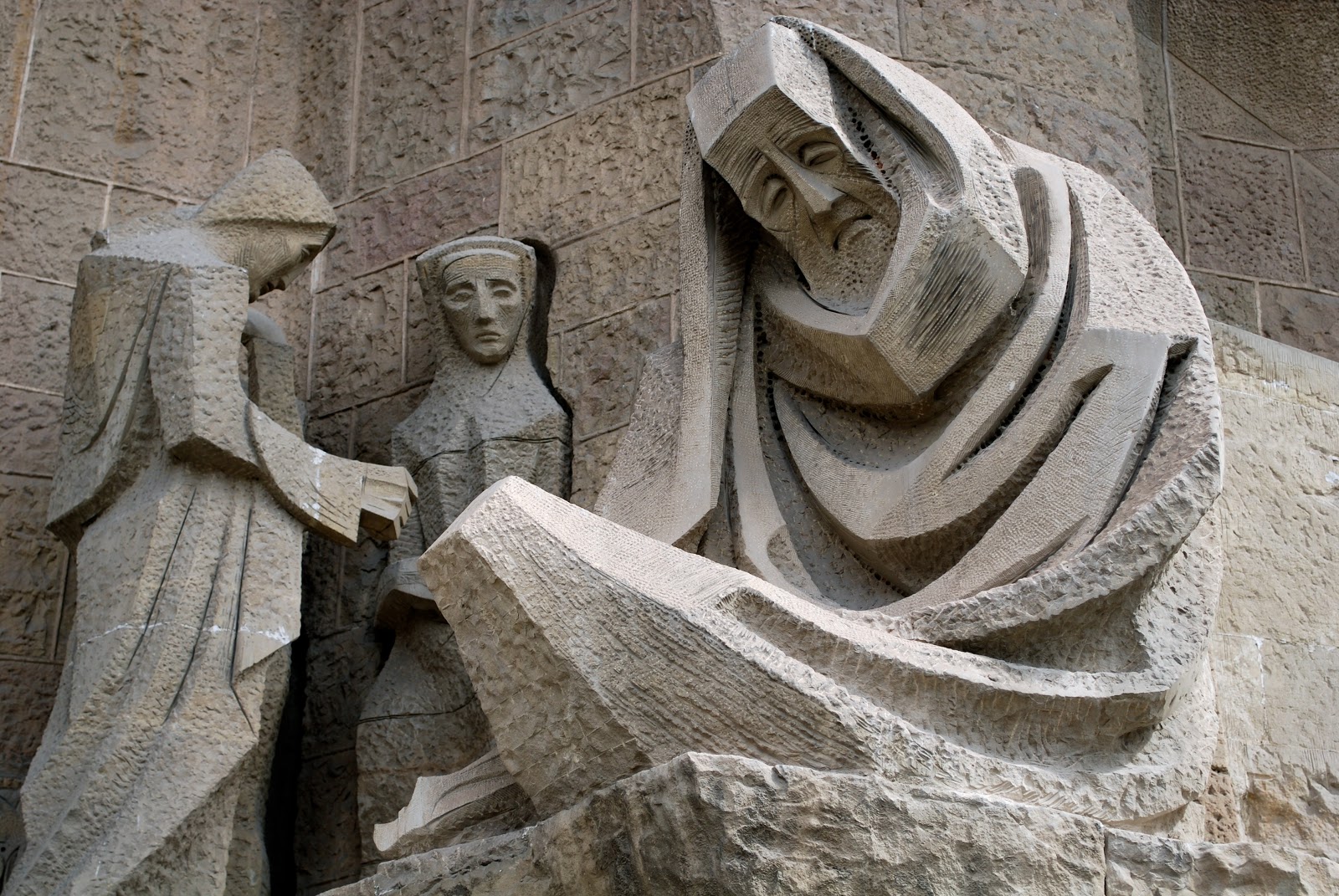
The Roman Catholic Church has been under construction since 1882 and is expected to continue until at least 2026. It was designed by Barcelona's most famous architect, Antoni Gaudí, who worked on the project for nearly 40 years until his death in 1926.
 |
| La Sagrada Familia |
 |
| La Sagrada Familia |
 |
| La Sagrada Familia |
 |
| La Sagrada Familia |
 |
| La Sagrada Familia |
 |
| La Sagrada Familia |
 |
| La Sagrada Familia |
 |
| Detail from La Sagrada Familia. |
I began my tour of the massive church in the museum, which was located in what will someday be the church’s crypt. The museum features dozens of photos from the construction of the church over the last 125 years and also includes many models of various forms of the church. In addition to viewing the displays, I also spent 20 minutes watching a movie that explained the history of the building and featured excerpts from construction that had occurred within the last ten years.
 |
| Workshop area of La Sagrada Familia |
Next, I took an elevator (located at the nativity facade) to the top, where I admired views of the two towers and of the construction that was taking place all around and below me. Although the sun was trying its best to come out, it was still quite cloudy and gray so I was not happy with how the photos turned out.
 |
| Detail from La Sagrada Familia. |
 |
| View from La Sagrada Familia. |
 |
| La Sagrada Familia |
 |
| La Sagrada Familia |
 |
| La Sagrada Familia |
 |
| La Sagrada Familia |
 |
| La Sagrada Familia |
 |
| View from La Sagrada Familia. |
 |
| La Sagrada Familia |
 |
| La Sagrada Familia |
I eventually made my way into the ridiculously crowded nave, which was a crazy construction zone of dust, drilling, and scaffolding. However, beyond all of the chaos, it was easy to appreciate the architecture of the interior, especially the columns, which branched off into the ceiling like trees. I had read that the church was scheduled to be completely finished in 20 years, around 2030. We’ll see if that actually happens, but whenever it does, I hope I’m still alive and get to see it as it was always intended to appear.
 |
| Interior of La Sagrada Familia. |
 |
| Interior of La Sagrada Familia. |
 |
| Interior of La Sagrada Familia. |
 |
| Interior of La Sagrada Familia. |
 |
| Interior of La Sagrada Familia. |
 |
| Interior of La Sagrada Familia. |
 |
| Interior of La Sagrada Familia. |
 |
| La Sagrada Familia |
 |
| La Sagrada Familia |
 |
| La Sagrada Familia |
 |
| La Sagrada Familia |
 |
| La Sagrada Familia |
 |
| La Sagrada Familia |
 |
| La Sagrada Familia |
 |
| La Sagrada Familia |
After I was finished at La Sagarada Familia, I took the metro to
Parc de la Ciutadella. Unfortunately, one of the main focal points of the park, the Cascade Fountain, was covered in scaffolding and netting so I was only able to enjoy views of the lower fountains. Luckily, it was at this time that the sun finally came back out in full force after being unable to make up its mind for several hours, so I was happy, scaffolding or not. Within the park I also saw a beautiful lake and the Parlament de Catalunya. I continued the walk through the pleasant and un-crowded park until I reached the charming Barri Gotic neighborhood.
 |
| Parc de la Ciutadella |
 |
| Parc de la Ciutadella |
 |
| Parc de la Ciutadella |
 |
| Parc de la Ciutadella |
 |
| Parc de la Ciutadella |
 |
| Parc de la Ciutadella |
 |
| Parc de la Ciutadella |
 |
| Parc de la Ciutadella |
 |
| Parc de la Ciutadella |
 |
| Parc de la Ciutadella |
 |
| Parc de la Ciutadella |
 |
| Parc de la Ciutadella |
 |
| Parc de la Ciutadella |
 |
| Parc de la Ciutadella |
 |
| Parc de la Ciutadella |
 |
| Parc de la Ciutadella |
 |
| Parc de la Ciutadella |
 |
| Parc de la Ciutadella |
 |
| Parc de la Ciutadella |
I eventually made my way to the
Picasso Museum, after strolling through a few back alleyways and lovely squares in Barri Gotic.
 |
| Barcelona's Barri Gotic (Gothic Quarter). |
 |
| Barcelona's Barri Gotic (Gothic Quarter). |
 |
| Barcelona's Barri Gotic (Gothic Quarter). |
 |
| Barcelona's Barri Gotic (Gothic Quarter). |
The
Picasso Museum in Barcelona houses one of the largest collections of works of art completed by the Spanish artist Pablo Picasso. The museum is housed in five adjoining medieval palaces that provide a fascinating architectural backdrop to the art on display. I opted to purchase the Articket Card at the museum, which only cost 20 Euros but included entrance to seven other museums within the city, including three that I would visit the following day. The museum was well laid-out and easy to follow and not at all overwhelming. Each of the rooms were organized by a time period in Picasso’s life with many of his early works on display. Prior to visiting this museum, when someone mentioned Picasso, I instantly thought of his modern Cubism art. I had absolutely no idea that Picasso’s early work included many realistic pieces and a few impressionist ones.
 |
| Picasso Museum |
After spending about one hour at the museum, I traveled by metro back to
Las Ramblas, where I visited
La Boqueria again, since I was only able to devote just a small amount of time the day prior. Although I was visiting at a much earlier time than the day before (15:00 instead of 17:00) many of the market stalls were already beginning to shut down, especially the ones selling meat and fish. I wandered my way through the maze of stalls, before eventually buying two containers of mixed fruit for only one Euro each; what a deal!
 |
| La Boqueria |
 |
| La Boqueria |
 |
| La Boqueria |
 |
| La Boqueria |
 |
| La Boqueria |
 |
| La Boqueria |
 |
| La Boqueria |
 |
| La Boqueria |
 |
| Fruit purchased from La Boqueria. |
After the market, I headed off Las Ramblas to a street called Carme Portaferrissa, where I turned right onto Carrer Petritxol, as I wanted to stop in for churros con chocolate at
Granja La Pallaresa. Unfortunately, the restaurant wasn’t scheduled to open for at least an hour longer, so instead I walked into a chocolate shop two stores down and bought some delicious cookies. I then snacked on my cookies as I walked through the surrounding neighborhood.
 |
| Chocolate store in Barcelona. |
 |
| Chocolate store in Barcelona. |
 |
| Chocolate store in Barcelona. |
 |
| Cookies I purchased from a chocolate store in Barcelona. |
 |
| Street scenes from a walk through Barcelona. |
 |
| Street scenes from a walk through Barcelona. |
 |
| Street scenes from a walk through Barcelona. |
 |
| Street scenes from a walk through Barcelona. |
 |
| Street scenes from a walk through Barcelona. |
Afterward, I headed north to
Casa Batlló, another Gaudí creation. The building was initially built in 1877 but was later remodeled by Gaudí between 1905 to 1907. As previously mentioned, I had wavered back and forth as to whether or not I should visit this building due to its ridiculously high entrance fee (16.5 Euros per person), but alas, I was called to visit by its promises of beautiful and unique architecture, which I am always a sucker for. The entrance fee also included an audio guide.
 |
| Exterior of Casa Batllo. |
 |
| Exterior of Casa Batllo. |
 |
| Exterior of Casa Batllo. |
 |
| Interior of Casa Batllo. |
 |
| Interior of Casa Batllo. |
Although most people began the tour on the ground level floor, I opted to start all the way at the rooftop, in order to take advantage of the setting sunlight on the whimsical chimneys. I was able to get several great shots of the chimneys which really thrilled me.
 |
| Rooftop of Casa Batllo. |
 |
| Rooftop of Casa Batllo. |
 |
| Rooftop of Casa Batllo. |
 |
| Rooftop of Casa Batllo. |
 |
| Rooftop of Casa Batllo. |
 |
| View from the rooftop of Casa Batllo. |
 |
| Rooftop of Casa Batllo. |
 |
| Rooftop of Casa Batllo. |
 |
| Rooftop of Casa Batllo. |
 |
| Rooftop of Casa Batllo. |
 |
| Rooftop of Casa Batllo. |
 |
| Rooftop of Casa Batllo. |
 |
| Rooftop of Casa Batllo. |
After touring the rooftop, I then descended down the stairs to begin touring the rooms, which to my surprise, only covered the top floor and first two floors. The rest of the floors contained private residences and were therefore obviously closed to the public. My favorite rooms were definitely the attic with its incredibly gorgeous arches and one of the rooms on the bottom floor, which faced the street and featured beautiful stained glass walls and an amazing light fixture set in the ceiling in a swirl pattern. Overall, I was happy I had visited Casa Batlló and glad that I had been able to obtain great photos of the rooftop; however, I strongly feel that their entrance fee is too high and quite unnecessary; someone is making a HUGE profit off of this place!
 |
| Interior of Casa Batllo. |
 |
| Interior of Casa Batllo. |
 |
| Interior of Casa Batllo. |
 |
| Interior of Casa Batllo. |
 |
| Backyard of Casa Batllo. |
 |
| Backyard tile at Casa Batllo. |
 |
| Interior of Casa Batllo. |
 |
| Interior of Casa Batllo. |
 |
| Interior of Casa Batllo. |
 |
| Interior of Casa Batllo. |
 |
| Interior of Casa Batllo. |
 |
| Interior of Casa Batllo. |
 |
| Interior of Casa Batllo. |
 |
| Interior of Casa Batllo. |
 |
| Interior of Casa Batllo. |
 |
| Interior of Casa Batllo. |




 Posts
Posts


